Youth brought together artificial intelligence and art to combat digital violence
Date:
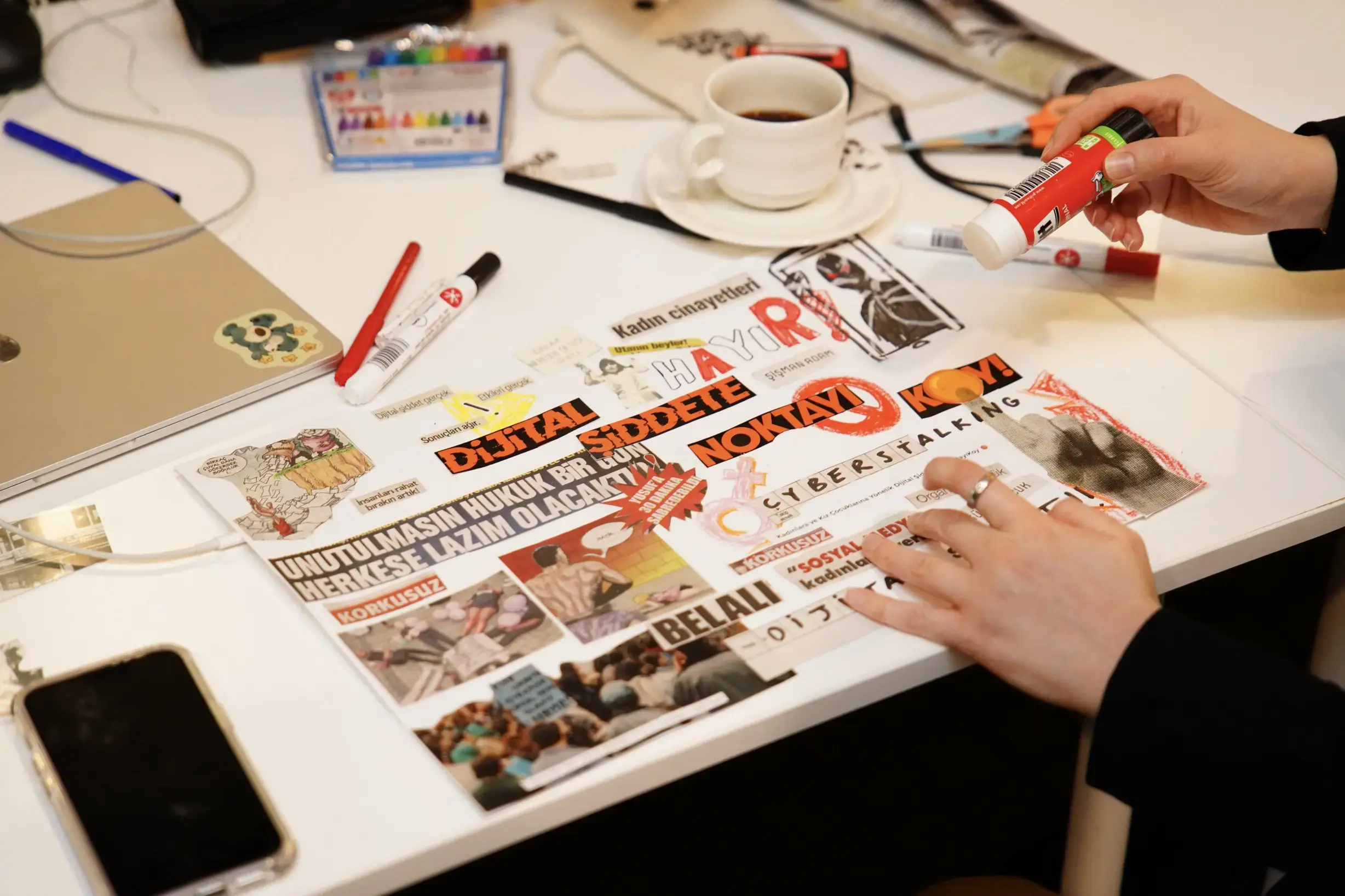
Youth came together at the fanzine workshop held as part of the “End Digital Violence, Full Stop 🟠” campaign. Photo: UN Women.
Organized in Ankara within the scope of the 16 Days of Activism Campaign and in collaboration with UN Women and UNFPA Turkey Offices, the “End Digital Violence Full Stop!” workshop strengthened young people’s awareness and capacity to address digital violence. Throughout the program, participants discussed the layered nature of digital violence with experts, developed AI-supported tools, and made their experiences visible through art.
From grasping digital violence to collective production: knowledge, artificial intelligence, and art together
In the first session of the workshop, digital violence experts Nurcihan Temur and Pınar İlkiz examined the conceptual framework of online violence together with the youth. The session discussed many forms of digital violence such as catfishing, doxing (the disclosure of personal information), cyberflashing, gendered disinformation, online impersonation, malicious distribution, and mass reporting. The participants engaged in an interactive exercise that emphasized that digital violence is not only a technical issue, but also a social, cultural, and political problem.
In the second session of the program, digital activist and musician Beyza Doğuç conducted the workshop “Creating a GPT – Collective Artificial Intelligence Training” together with the participants. Young participants carried out a hands-on exercise on how artificial intelligence can be used to combat digital violence and tested the digital assistant.
The “Digital Art Workshop,” held in the afternoon, was facilitated by artists Zeynep Beler and Efe Levent. During the workshop, participants produced collages, expressing different forms of digital violence through artistic practices.
Stating that they believe the best way to understand what digital violence is and what its impacts are is to listen to how young people feel, Efe spoke about the participants’ engagement as follows: “For this reason, we thought that the fanzine format would be very appropriate, as it allows participants to express their emotions through artistic practices that do not require specialized training. The fact that this medium, used since the 1980s to rapidly circulate raw emotions and ideas thanks to its low cost and ease of production, was embraced by participants with great enthusiasm made us extremely happy.”
“We find analog forms of production particularly valuable in this era in which digitality surrounds every aspect of our lives. The enthusiastic engagement of young people was a powerful response to this.”
Zeynep Beler, Artist
Image
Dijital Sanat Atölyesi’nde gençler, deneyimlerini kolajlar üzerinden ifade ediyor. Fotoğraf: UN Women
Dijital Sanat Atölyesi’nde gençler, deneyimlerini kolajlar üzerinden ifade ediyor. Fotoğraf: UN Women
Dijital Sanat Atölyesi’nde gençler, deneyimlerini kolajlar üzerinden ifade ediyor. Fotoğraf: UN Women
At the Digital Art Workshop, young participants express their experiences through collages. Photo: UN Women.
Young people’s experiences: The multilayered nature of digital violence
The experiences shared voluntarily by participants during the workshop powerfully revealed both the diversity of digital violence and how it is perceived by young people. Emphasizing that digital violence reproduces gender inequalities in online spaces, Suche Coşkun stated: “We wanted to show that digital violence is not an individual issue, but a social one. The workshop was very instructive; I learned how important it is to collect evidence and to know the right steps to take. I feel more informed and empowered.”
“We created this collage to highlight how, in a time when traditional mechanisms of oppression are being transferred into online spaces, technology has become not so much a space of liberation as a tool for new forms of surveillance, harassment, and control. Through the key concepts emphasized in the collage, we aimed to reflect the various forms of online violence against women. At the same time, the collage seeks to make visible that digital violence is a problem in which gender inequalities are reproduced in online environments.
The phrases ‘not once, not twice, but three, four, five times’ in the collage depict a constant state of being watched and monitored. Through the male figures in the cartoons and expressions such as ‘Hooh! Hoouh!’, we aimed to offer an ironic critique of the harassing yet normalized language commonly encountered on digital platforms. Ultimately, by underlining that digital violence is not an individual struggle but a political and social issue, we emphasized the importance of collective action."
Emphasizing that digital violence is not merely a technical problem, Abide Tuncer stated: “We discussed many issues, ranging from violence in language to algorithmic discrimination, and from digital consent to the protection of privacy. Digital violence does not remain confined behind a screen; it is a social issue that affects relationships, trust, and even career trajectories. Seeing how empowering AI tools can be when used correctly gave me hope.”
Addressing the impacts of artificial intelligence and digital transformation on violence through their own collage, Denys Bastan noted that the workshop provided an opportunity to engage with new concepts, stating: “Defining the types and concepts of digital violence was extremely valuable. I gained awareness for safer use on social media platforms, and expressing these issues through art was very meaningful.”
Existing as a woman in men’s world
Ecrin Sezer, drawing attention to women’s struggles for existence in digital spaces through her collage titled “Existing as a Woman in a Men’s World,” stated: “Learning that the things we experience have names and feeling that I am not alone was very empowering. I gained important knowledge about how to manage my digital visibility.”
“The male figures concentrated at the very bottom of my collage are images drawn from almost every area of life. Although men appear as the majority, the women who overflow from within their gray theme increase from the center of my collage toward the top. When we look at it, we can see just how diverse and colorful the spaces women occupy and women themselves truly are.”
Emphasizing the impact of collective production through art, Eylül Seneger shared her workshop experience as follows: “We became familiar with many forms of digital violence that we could not previously name. The process of collective production was very meaningful; it made me feel the importance of existing safely in digital spaces. It became a project that highlighted the importance of greater visibility, freedom, and women’s ability to exist safely in the digital world.”
Evaluating the work she prepared with the UNV team, Şevval Hakbilen drew attention to the layered nature of digital violence, stating: “I discussed concepts such as catfishing, cyberstalking, and doxxing this clearly for the first time. Through the concept puzzle in the collage, we aimed to show how different forms of digital violence feed into one another. I left the workshop feeling more aware and more resilient.”
“The central theme of the collage is digital violence. For this reason, we included visual elements that emphasize the invisibility of anonymous perpetrators and the ambiguous forms of threat that emerge in digital environments. The mobile phone placed within an old painting in the collage points to historical continuity: even though the form of violence changes, gender-based violence has existed for centuries. Digital tools merely represent the new appearance of this violence; its roots continue to lie in the historical structures of gender inequality. The orange dot in the collage represents the campaign slogan ‘End Digital Violence Full Stop!’, making visible both the shared framework of all the works and a clear call to action.”
16 Days of Activism: End Digital Violence. #FullStop🟠
16 Days of Activism is an international campaign carried out each year to raise awareness and advocate for ending all forms of violence against women and girls. It begins on 25 November, the International Day for the Elimination of Violence against Women, and continues until 10 December, Human Rights Day. This year, for the first time in Türkiye, the “End Digital Violence 🟠” campaign—implemented jointly by UN Women and UNFPA—focused on technology-facilitated violence, one of the fastest-growing forms of violence, in short: digital violence. As part of this campaign, the “End Digital Violence!” workshop enabled young people to recognize digital violence, express their experiences, and develop solutions. Participants created the fanzine using photographs from the Women’s Library and Information Centre Foundation, one of UN Women’s civil society partners.
Atölye kapsamında farklı kolajlardan yapılan dijital fanzin.